


The Straits Times, 22 Mar 2007
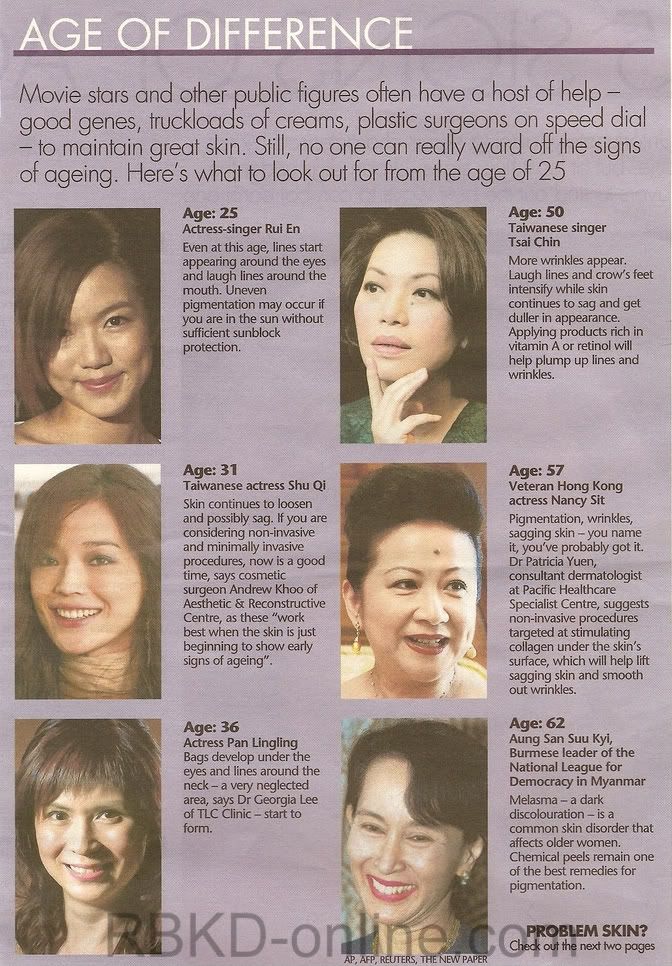
Movie stars and other public figures often have a host of help – good genes, truckloads of creams, plastic surgeons on speed dial – to maintain great skin. Still, no one can really ward off the signs of ageing. Here’s what to look out for from the age of 25.
Age: 25
Actress-singer Rui En
Even at this age, lines start appearing around the eyes and laugh lines around the mouth. Uneven pigmentation may occur if you are in the sun without sufficient sunblock protection.
Source: The Straits Times
Categorised in The Straits Times.
The Straits Times, 19 Mar 2007
The Monday Interview
Bryan Wong started in showbiz at the age of eight, starred in the bomb Masters Of The Sea, and has survived it all to be last year’s top TV host.
He has made a name for himself as a host of Chinese programmes, but will be appearing in his first MediaCorp drama in July. The Channel 8 show about life in the army was commissioned by the Ministry of Defence, and he co-stars with actors Tay Ping Hui and Rui En.
Source: The Straits Times
Categorised in Honour and Passion å®å®¶å«å›½, The Straits Times.
The Straits Times, 12 Dec 2006
HOW do the five starlets fare in the eyes of industry players? Hairstylists David Gan (DG) and Addy Lee (AL), MediaCorp’s managing executive producer Lee Ee Wurn (LEW) and Life!’s Lee Sze Yong (LSY) rate them out of a total of five points.
Rui En, 24
SHE models, acts and sings. The former Raffles JC girl was first talent-spotted by Hype Records in 2001 after appearing in a SingTel TV ad, and then did a cameo in the Channel 8 drama serial No Problem. She also starred in the recent Love @ 0 deg C.
DG: 3.5/5. She is hardworking and her X-factor is just waiting to explode. Her forthright character may work against her, though.
AL: 2/5. I didn’t expect her to be in the Top 10 again this year. She has this very cold image that is not appealing to me.
LEW: 3/5. Her acting is average, and the impression she projects is a sense of arrogance, which works against her. However, she has the attitude other starlets don’t.
LSY: 3.5/5. Rui En is a rebel in the making. Pubescent fans should take to her attitude, but she’ll need to work harder to charm the uncles and the aunties.
Total: 12/20
Source: The Straits Times
Categorised in The Straits Times.
The Straits Times, 12 Dec 2006
Five fresh faces stood out at Sunday’s Star Awards, but can one of them become the next Zoe or Fann?
Lee Sze Yong
MEDIA REPORTER
GASPS of surprise could be heard when the words “Quan Yifeng†rolled off presenter Zax Wang’s tongue on Sunday night.
Quan, an eloquent show host, was the last name on the coveted Top 10 Most Popular Female Artistes list at the annual MediaCorp Star Awards ceremony.
No, the artistes and fans gathered at St James Power Station were not surprised that the glib-tongued host made it to the list, which is decided by viewers through a telepoll and a survey of 600 Singaporeans.
Rather, they were stunned by who did not make it this year: Best Actress Ivy Lee – out. Former Star Search champion Jacelyn Tay – out. Much talked-about new face Joanne Peh – out.
Instead, the night belonged to Felicia Chin, Fiona Xie, Jeanette Aw, Jesseca Liu and Rui En.
These newer faces took their place on stage with veterans like Quan, Kym Ng, Huang Biren, Xiang Yun and Michelle Chia in the Top 10 category.
Could the five girls usher in a new era of TV actresses? Pretty, talented and all under 28, they are already being talked about as The Next Big Things to come out of Caldecott Hill.
Could one of them emerge to reach the heights of popularity that Tay and Fann have?
The five are not exactly new faces. But, sometimes, it takes time before an actress registers in the public consciousness and is catapulted to the next level of fame.
Source: The Straits Times
Categorised in Star Awards, Star Awards 2006, The Straits Times.
08 December 2006
THESE are the nominees for this year’s awards:
Top 10 Most Popular Female Artistes:
Pan Lingling, Joanne Peh, Fiona Xie, Kym Ng, Xiang Yun, Rui En, Patricia Mok, Bukoh Mary, Priscelia Chan, Quan Yifeng, Yvonne Lim, Jacelyn Tay, Jesseca Liu, Huang Biren, Michelle Chong, Michelle Chia, Jeanette Aw, Ivy Lee and Felicia Chin.
Source: The Straits Times
Categorised in Star Awards, Star Awards 2006, The Straits Times.
02 December 2006
Motorola dials into the charitable mode with red phones endorsed by 14 local celebs
IT MAY not be Motorola’s latest phone, but 14 local celebrities won’t be caught using anything other than Motorola’s Moto Red Motorazr V3.
The group, which includes Eunice Olsen, Rui En, Beatrice Chia-Richmond and Jonathan Leong, showed up as non-paid ambassadors at yesterday’s launch of Motorola’s charity project Moto Red.
While they get the phones free, Motorola says several have offered to pay for them.
The six-year Moto Red project aims to help eliminate Aids in Africa through the sale of specially designed red phones from popular lines, starting with the Motorazr V3.
From next month, the 14 local celebrities will appear in Project Red posters in newspapers and magazines for free.
Source: The Straits Times
Categorised in The Straits Times.
13 October 2006
Despite his drink driving troubles, Christopher Lee is in the running for the 2006 Star Awards’ Top 10 Most Popular Male Artiste award.
Lee Sze Yong
MEDIA REPORTER
New face Elvin Ng and Project SuperStar champion Kelvin Tan will also be contesting the Most Popular Newcomer award, along with female artistes Chew Sin Huey, Candyce Toh and Dawn Yeoh.
Chew, a first-timer in the race, will face competition from 19 female artistes for the Top 10 Most Popular Female Artistes award.
They are: Pan Lingling, Joanne Peh, Fiona Xie, Kym Ng, Xiang Yun, Rui En, Patricia Mok, Bukoh Mary, Priscelia Chan, Quan Yifeng, Yvonne Lim, Jacelyn Tay, Jesseca Liu, Huang Biren, Michelle Chong, Michelle Chia, Jeanette Aw, Ivy Lee and Felicia Chin.
Star Awards will be held on Dec 10 at MediaCorp’s TV Theatre. In previous years, voting took place one week before the awards ceremony. This year, telepoll lines will be open from next Tuesday to Dec 10, for two months. Calls cost 80 cents each.
A lead-up series, Star Awards Up-close, will air every Tuesday starting next week on Channel 8 to update voting results.
Source: The Straits Times
Categorised in Star Awards, Star Awards 2006, The Straits Times.
26 June 2006
Most people know Ken Lim as the stern and sometimes brutally honest Singapore Idol judge. But – surprise, surprise – there is a soft side to him, according to his friends and wife
The Monday Interview
Professional man
He started composing and producing soundtracks for Channel 8 drama serials like Return Of The Condor Heroes, and recording albums with local artistes such as Fann Wong and Ann Kok.
He had banked on people’s familiarity with them to “save on promotional budgetâ€. The albums did very well, he recalls drily, selling in the region of 20,000 each.
Hype has since branched out, with artiste management arm Artiste Network minding artistes like Phyllis Quek, Jeanette Aw and Rui En.
Other ventures include concert promotion – it organised concerts by Taiwanese stars Jay Chou and Mayday – and production.
He also took the unconventional path of marketing his artistes – such as Fann when she was still signed to Hype and, more recently, Rui En – overseas on his own.
Source: The Straits Times
Categorised in The Straits Times.
18 June 2006
Cool Speak on Sunday
She couldn’t string a proper sentence together in Mandarin but singer-actress-host Rui En, 25, has come a long way. She tells JEAN LOO how she worked hard at the language.
You were from Raffles Junior College and Singapore Chinese Girls’ School. How was your standard of Chinese in school?
I had many weekly Chinese tuition sessions from primary to secondary school, but my Chinese wasn’t good at all. Other than the assessment books and homework, the thing I remember most clearly was that I hated mo xie (dictation). I hated writing chunks of Chinese characters. Of course, my grades weren’t very good. I think it’s partly because my parents introduced me to English books when I was quite young, so I spoke English more and found Mandarin harder to pick up.
But you’ve acted in a number of Chinese drama serials like A Better Tomorrow and My Sassy In-Laws and even released a self-titled debut Mandarin album. How did you manage to accomplish all that?
Yes, that’s the irony of it all — memorising scripts is like studying mo xie. Both singing and acting were very difficult because they were in Mandarin and I had to struggle a lot. When I did the first few dramas, I didn’t have a clue what I was saying. I was focusing more on showing the right expressions. It was really very stressful because I knew my Chinese was bad. But it’s a lot easier now because I do a lot of research on the characters I play and make it a point to write out a whole history about the character. I think it’s important to understand why a character behaves in a certain way. Now, when I start filming, I can connect better with the character I’m playing. Then the dialogue comes more naturally and it’s not so much about memorising any more.
So why did you enter the Chinese market even though Mandarin isn’t your strongest suit?
Because I’m Chinese. Even though I started on the wrong foot and didn’t really concentrate on my Chinese in school, I think I’ve more than made up for it by now. When I started out in showbiz four years ago, my Mandarin was horrendous. It was so bad, I could not even put a simple sentence together, much less express myself. During my stint in Taiwan, where I starred in a couple of Taiwanese singer Jay Chou’s music videos, I was absolutely petrified. Their Mandarin was so advanced and there were many embarrassing incidents when I didn’t realise the mistakes I was making. For example, only child means du sheng nu, but to me it was dan sheng nu, which actually means single and available.
So how did you improve your command of the language?
From the start, I knew I had to improve my Mandarin. Of course, it took a lot of time, but I tried to speed it up as much as I could. I started watching a lot of Chinese variety shows and dramas with subtitles — which is one tip I have for readers who want to improve their Chinese. It really helped a lot. You read the subtitles on the screen and listen to the dialogue at the same time, putting the dialogue in context. This is more effective than if you were to read a Chinese book.
When I think back about how bad my Chinese was, I’m proud of how fluent I am now. It seemed an impossible task at first because I didn’t know how I was going to catch up. But I finally did through sheer hard work.
Source: The Straits Times
Categorised in The Straits Times.
